April 27, 2026
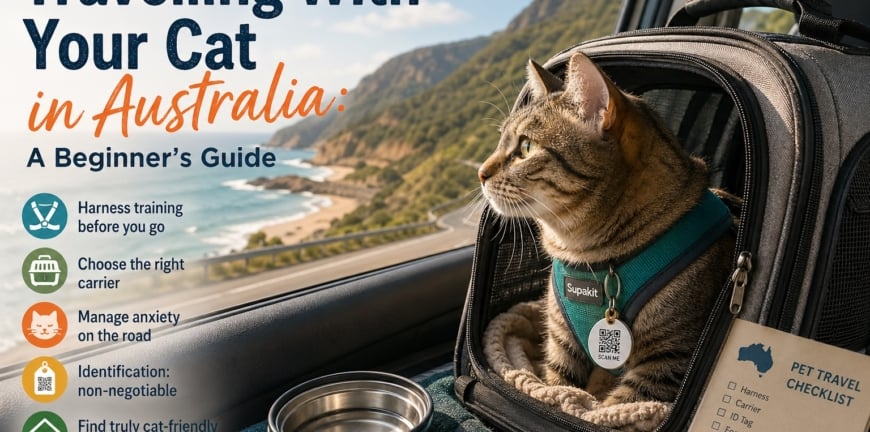
Travelling With Your Cat in Australia: A Beginner’s Guide
Travelling With Your Cat in Australia: A Beginner’s Guide.
Dog owners have had the pet travel thing figured out for years. Cats? Not so much. There’s a persistent myth that cats simply can’t travel – that they’re too independent, too anxious, too attached to their territory to cope with anything beyond the lounge room window. But anyone who’s spent time in a cat-friendly cabin in Victoria or watched their cat discover a new sunbeam in a holiday rental knows that’s not the full picture.
Cats can travel. Some even thrive on it. But they need a very different kind of preparation than dogs, and the mistakes most first-timers make are entirely avoidable. Only one of my cats was a natural traveller, the others took time to build their confidence to being on the road. Yet it’s not impossible with the right training, equipment and patience.
Whether you’re planning a weekend away to the coast or a longer road trip along the east coast, this guide covers everything you need to know to travel safely and happily with your feline companion.
Start With Harness Training – Weeks Before You Leave
This is the step that separates a smooth trip from a stressful one, and it can’t be rushed. Unlike dogs, most cats haven’t worn a harness before, and the first time you clip one on is not the morning of your departure.
A good cat harness fits snugly around the torso without restricting movement. Avoid anything designed for small dogs – choose cat-specific harnesses. Brands like Supakit or similar cat-specific harnesses are designed for the way cats move, with escape-proof buckles and a low-profile fit that sits behind the front legs rather than across the throat.
A rough training timeline:
- Week 1: Leave the harness near your cat’s food bowl and sleeping spots. Let them sniff it, bat it around, and get used to its presence.
- Week 2: Drape the harness loosely over your cat’s back during meals. Don’t clip it – just let them feel the weight.
- Week 3: Fasten the harness for short periods indoors – five minutes, then ten, then twenty. Reward with treats throughout.
- Week 4: Attach the lead and let your cat walk around inside the house. Follow them rather than leading – cats don’t heel like dogs.
Some cats take to this immediately. Others need longer. There’s no shortcut, and forcing the process will only create negative associations that make travel harder.
Choose the Right Carrier
Your cat’s carrier is their mobile safe space – their territory in miniature. Getting the right one matters more than most people realise.
For car travel, look for a carrier that’s crash-tested and well-ventilated. Sleepypod makes some of the safest options on the market, with carriers that double as comfortable beds so your cat already associates them with rest before you even get in the car. They’re not cheap, but if you’re planning to travel regularly, they’re a worthwhile investment.
For airline travel, check your carrier against the airline’s specific dimensions – most require soft-sided carriers that fit under the seat, with maximum dimensions around 46 x 28 x 24 cm.
Carrier training tips:
- Leave the carrier open in your home permanently, with a familiar blanket inside. Let your cat wander in and out on their terms.
- Feed meals inside the carrier (door open) for a few weeks before your trip.
- Spray the interior with Feliway – a synthetic feline pheromone that mimics the scent cats leave when they rub their face on objects. It signals safety and can noticeably reduce stress during transit.
- Never force your cat into the carrier. If they resist, go back a step in the training.
Managing Anxiety on the Road
Cats are creatures of habit, and travel disrupts every habit they have. The key is to minimise the shock rather than eliminate it entirely.
If your cat gets anxious in the car, start with short practice drives around the block – engine on, carrier secured, radio at a low volume. Gradually increase the duration over a few weeks. Some cats settle within minutes once they realise the car isn’t taking them to the vet. Others need more help.
Calming treats can take the edge off for moderately anxious cats. Carla has done an excellent deep dive on the best options available in Australia, and the Vetalogica Hemp Clinicals range came out on top for good reason – the combination of chamomile, tryptophan, and hemp works well for most cats without sedating them.
For cats with more severe travel anxiety, speak to your vet about prescription options before the trip. This isn’t a failure – it’s responsible preparation, just as you’d consider calming aids for an anxious dog.
Other practical anxiety reducers:
- Cover the carrier with a light blanket during the drive. Reducing visual stimulation helps most cats settle faster.
- Play soft classical music or cat-specific calming playlists (yes, they exist, and some research suggests they work).
- Avoid feeding a full meal right before driving – a light snack is fine, but a full stomach plus motion can lead to car sickness.
- Bring a worn t-shirt or pillowcase that smells like home and tuck it into the carrier.
Identification: The Non-Negotiable
In Australia, microchipping is compulsory in every state and territory. But a microchip is only half the equation – it requires a scanner, a database lookup, and up-to-date contact details. If your cat slips out of an unfamiliar holiday rental at 9pm on a Saturday in regional NSW, a microchip alone isn’t going to get them home quickly.
This is where visible identification becomes critical. Cats are harder to catch than dogs, and a frightened cat in an unfamiliar area may not let a stranger get close enough to read an engraved tag – assuming the tag hasn’t been lost, which happens regularly with cats that climb, squeeze through gaps, and push through scrub.
A collar tag with a scannable profile is particularly useful for travelling cats because the information can be updated before each trip. You can add the address of your accommodation, the nearest emergency vet, and any notes about your cat’s temperament or medical needs – details that help a finder know whether they’re dealing with a friendly ragdoll or a nervous rescue that shouldn’t be cornered. The scan works without an app, which matters because the person who finds your cat at a caravan park in the Grampians is unlikely to download anything.
For owners who want location tracking as well, Tractive now makes a GPS tracker small enough for cat collars, with a virtual fence feature that alerts you if your cat leaves a designated area – handy for holiday rentals where you might let your cat explore a fenced garden.
A belt-and-braces approach – microchip, visible digital tag, and GPS for higher-risk situations – gives you the best chance of a quick reunion if things go sideways.
Finding Genuinely Cat-Friendly Accommodation
Here’s the hard truth: “pet-friendly” usually means “dog-friendly.” Plenty of properties that happily welcome a Labrador will hesitate when you mention a cat, and the reasons aren’t unreasonable – cats can scratch furniture, spray in unfamiliar environments, and find escape routes that dogs would never attempt.
Calling ahead is essential. Don’t rely on a “pets welcome” badge on a booking platform. Ask specifically:
- Are cats allowed indoors? Some properties only permit pets outside, which defeats the purpose for most cat owners.
- Is the property escape-proof? Check for gaps in fencing, open windows without screens, and cat flaps that lead outside. A cat in a new environment will explore every possible exit.
- Are there resident dogs on the property? A cat-friendly cabin loses its charm if the property dog patrols the garden.
- Is there a bond or cleaning fee? Most places charge one, and knowing upfront avoids awkward conversations at checkout.
For verified options, the Pet Friendly Accommodation locator is the best starting point in Australia. You can filter by state, and many listings specify whether cats are welcome – not just dogs.
Also worth considering: pet travel insurance. Policies vary widely, but some cover emergency vet bills, accommodation changes if your pet falls ill, and even costs associated with a lost pet. For interstate trips, it’s worth the peace of mind.
Setting Up Your Accommodation for a Cat
The first hour in a new space sets the tone for your cat’s entire stay. Get it right and they’ll settle by the evening. Get it wrong and you’ll spend the weekend coaxing a terrified cat out from under the bed.
The “one room” technique:
- Choose one room in the property – ideally a bedroom – and set it up as your cat’s base. Put their litter tray, water bowl, food, and a familiar blanket in there.
- Let your cat out of the carrier into this room only. Close the door.
- Let them explore at their own pace. Some cats will be confident within an hour. Others need a full day.
- Once they’re relaxed in the base room – eating, grooming, using the litter tray – gradually open up the rest of the property, one room at a time.
What to bring:
- A portable litter tray and enough litter for the trip (don’t assume the property provides one)
- Your cat’s usual food – a trip is not the time to experiment with new brands
- Familiar items: a blanket, a favourite toy, their regular scratching post if it’s portable
- Enzyme cleaner, just in case
- A collapsible water bowl for stops along the way
Australian-Specific Considerations
Travelling with a cat in Australia comes with some unique considerations that don’t apply in other countries.
Wildlife. Australia’s native fauna is particularly vulnerable to cat predation. Even well-fed domestic cats will hunt if given the opportunity. Keep your cat indoors or on a harness at all times – this isn’t just responsible ownership, it’s legally required in many council areas, especially near national parks and conservation zones. Many pet-friendly places in the Grampians and other natural areas have strict pet policies precisely because of wildlife concerns.
Ticks. If you’re travelling along the east coast, particularly in Queensland or northern NSW, paralysis ticks are a serious risk for cats. Symptoms include wobbliness in the back legs, a change in voice, and difficulty breathing. Prevention is essential – speak to your vet about tick prevention products suitable for cats before you travel, and do a thorough tick check every evening. Paralysis ticks are a serious risk along the east coast. RSPCA Australia recommends daily checks and preventative treatment when travelling in tick-prone regions.
Heat. Australian summers can be brutal. Never leave your cat in a car, even for a few minutes. Carry extra water, ensure the carrier is well-ventilated, and travel during the cooler parts of the day when possible. If your accommodation doesn’t have air conditioning, check before you book – a cat in a hot, unfamiliar space is a recipe for distress.
Council regulations. Cat containment laws vary by state and even by council area. In the ACT, for example, cats must be contained to their owner’s property at all times. In parts of South Australia and Victoria, similar rules apply. Check the local council rules for your destination before you arrive.
It Gets Easier
The first trip with your cat will almost certainly involve a few stressful moments – a yowl from the carrier on the highway, a tense first hour in the rental, a 3am patrol of an unfamiliar hallway. That’s normal.
But cats are adaptable creatures, and once they learn that travel leads to new sun patches, interesting smells, and the same human who feeds them at home, most begin to take it in stride. The cats you see on Instagram lounging in campervans and exploring coastal paths didn’t start that way. They started with harness training in the kitchen and short drives around the block.
The investment in preparation pays off every single trip after the first. And there’s something genuinely special about watching your cat discover a new place – ears forward, whiskers twitching, tail up – that makes all the work worth it.
If you’re considering planning your first pet-friendly getaway, don’t assume the cat has to stay home. With the right preparation, they might just become your favourite travel companion.