August 10, 2026
Road-Tripping With Your Dog: What Actually Affects Your Car Insurance Premium
Road-Tripping With Your Dog: What Actually Affects Your Car Insurance Premium
Does having a dog increase your car insurance premium? Usually, not directly. But the way you use and modify your car for your dog can affect what you pay and what is covered.
Let us start with the honest bit, because it saves everyone time.
Your dog isn’t normally a direct pricing factor on a car insurance policy. Insurers generally price cover based on factors relating to the vehicle, drivers, usage, location, claims history and the policy itself.
So why does this article exist?
Because several things that dog owners do to their cars, and several habits that come with regular drive holidays, absolutely do sit on that list. Most of us have never connected the two. One of them, in particular, can quietly reduce what you get paid after a claim.
What insurers are actually pricing
Australian insurers publish their pricing inputs, and they are more mundane than most people expect. NRMA sets out how a car insurance premium is calculated, listing the vehicle’s age, make, model and value; details about the drivers; where the car is kept and how it is used; the cover level, excess and any optional benefits; eligible discounts; government charges; and claims experience.
Read that list again through a dog owner’s eyes. Three items are quietly relevant.
Garaging and usage. Regular long drives can change how the vehicle is used and how many kilometres it travels.
Claims experience. Both your own history and the likelihood of a future claim.
The vehicle itself. Which brings us to the part that catches people out.
The bit almost nobody declares
Here is the genuinely useful thing in this article.
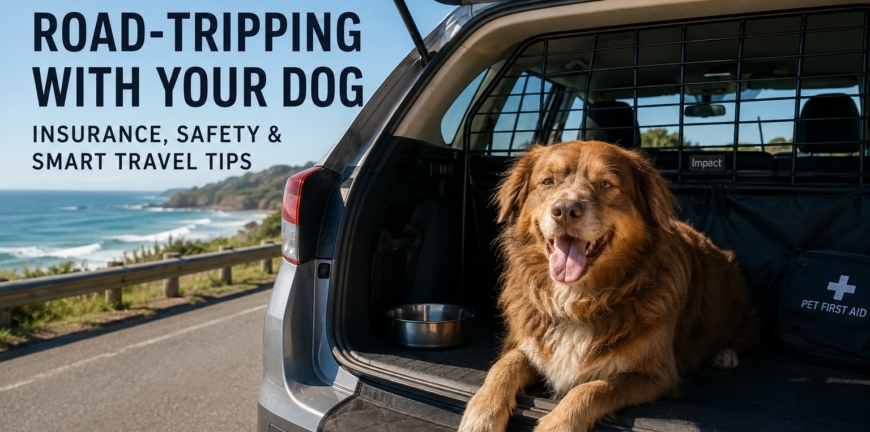
Cargo barriers. Fitted crates that bolt to anchor points. Cargo liners and boot floors. Window guards. Roof racks and canopies. Tow bars added so the trailer or camper can come along. Ramps built into the tailgate for older dogs who can no longer jump.
Fixed accessories and modifications can be relevant to your insurance, so check with your insurer before fitting them. Don’t assume that an accessory is automatically covered simply because it isn’t permanently attached.
Insurers ask to be told about modifications, and the reason matters. NRMA’s guidance states that if you do not tell them about modifications, the amount you receive when a claim is evaluated or settled may not take those modifications into account. It also notes that market value is worked out considering the car’s condition, age and any modifications made.
If you spend hundreds of dollars on a cargo barrier and don’t tell your insurer, don’t assume that its value will automatically be included in a future claim settlement.
Declaring it is not a punishment. When an insurer agrees to update the policy, they will tell you whether an extra premium applies or a refund is due and reissue your paperwork to match. Sometimes the change is negligible. The point is that the paperwork matches the vehicle sitting in your driveway.
Worth a phone call ahead of your next big trip, particularly if the fit-out happened years ago and nobody thought to mention it.
Restraint, distraction and the claims connection
This is where dogs genuinely intersect with premiums, though not in the way people assume.
The RSPCA’s guidance on restraining a dog in the car makes the safety case clearly. A properly restrained dog has less opportunity to move around the cabin and distract the driver, reducing one potential source of distraction.
The same guidance warns that plenty of restraint products on the market have never passed safety or crash testing, so a harness being sold for the purpose does not guarantee it performs in a collision. Restraint laws also differ between states and territories, which matters enormously on any trip crossing a border.
Follow the logic through to the insurance side. Claims experience is a pricing factor.
A loose dog can distract the driver, increasing the potential for an incident. If an incident results in a claim, your claims history may subsequently be relevant to future premium calculations.
For example, NSW Government explicitly says animals can be a distraction and advises drivers to limit the number of animals they carry; it also says you must not drive with an animal in your lap.
There may be an indirect connection through your overall claims history, but you shouldn’t expect restraining your dog to reduce your premium. The clearer benefit is safety: a properly restrained dog is less likely to distract the driver or be thrown around the vehicle in a crash.
While we are here, two more points from the RSPCA. Never leave a dog unattended in a parked car, because heat stress develops frighteningly fast even in mild weather. And check the specific road rules for every state you will drive through, rather than assuming your home rules travel with you.
Setting the car up properly
There is a difference between throwing a towel across the back seat and actually preparing a vehicle for a long drive.
The advice in this publication’s piece on the future of dog-friendly travel in Australia covers the practical kit well, from a dog mattress and seatbelt attachment through to a booster seat for smaller dogs, door guards, a collapsible water bowl and a first aid kit. It also makes a point worth repeating: build up with short trips first, so you learn how your dog copes before committing to six hours of highway.
Two additions from the insurance angle.
Anything bolted, screwed or permanently fixed belongs in the declaration conversation. For removable equipment, check your policy rather than assuming it is automatically covered or excluded.
And check your product disclosure statement on how damage caused by an animal you are carrying is treated. Policies differ, and this is one of those details far better discovered on a wet Tuesday at home than at a claims desk after your labrador has redecorated the rear door trim.
If you have to claim halfway through a trip
This is the scenario nobody plans for, and it is worth two minutes of thought before you leave.
Something happens hundreds of kilometres from home. The car is undriveable. A tow truck is coming, there is a claims line to call, and one very confused kelpie is watching proceedings from the verge.
Several practical questions arrive at once, and the answers live in your policy rather than in the moment.
Will the tow take you somewhere useful, or just to the nearest safe place? Those are different things, and the distance covered varies between policies and cover levels.
Does your cover include any emergency transport or accommodation after an incident, and up to what limit? Some comprehensive policies do, and the amount differs by tier. Then the follow-up question that only pet owners ask: is the accommodation you can actually book with a dog going to fall inside that limit, given pet-friendly stays often carry a nightly pet fee on top of the room rate?
If a hire car is included or added as an option, what size is it? A compact sedan is awkward when your whole set-up assumed a wagon with a fitted barrier.
Knowing the answers changes nothing about what you pay. It changes how a genuinely bad day unfolds. Reading those three answers off your Certificate of Insurance before departure costs nothing and occasionally saves a holiday.
Premium and excess are not the same thing
A quick clarification, because these get muddled constantly and the difference bites at exactly the wrong moment.
Your premium is the total amount you pay to hold the policy, annually or by instalments. Your excess is what you contribute out of pocket when you make an at-fault claim. Several different excesses can apply depending on circumstances, and the ones relevant to you are listed on your policy paperwork.
Choosing a higher excess generally lowers the premium. That trade only works if the excess is a figure you could genuinely produce at short notice, which is worth thinking about carefully when the claim might happen 400km from home with a dog in the back and accommodation booked.
Five things to sort before the next drive
- List every fixed modification. Barriers, tow bars, racks, canopies, permanent liners, ramps. If it needed tools, it counts.
- Ring your insurer and declare them. Ask directly whether the premium changes and request the updated Certificate of Insurance.
- Check your restraint properly. Look for evidence of crash testing rather than marketing copy, and confirm it suits your dog’s size.
- Read the relevant section of your PDS. Specifically on animals in the vehicle, and on what your excess would be.
- Update your details if anything has changed. A new address, a different garage arrangement, or another regular driver all feed the calculation.
Not one of these takes an afternoon, and every one is easier now than during a claim.
Then go somewhere good
With the admin sorted, the fun part. There are excellent short runs within easy reach of Sydney, and this site’s three dog-friendly road trips outside of Sydney cover a few, including Shoalhaven at roughly 191km and the Hawkesbury at around 141km, both with proper off-leash space at the far end.
Distances like those are also a reminder of the smaller point running underneath all of this. Holiday kilometres accumulate across a year, and usage sits on the pricing list.
Declare the gear. Restrain the dog. Then let him hang his ridiculous face out of a half-open window somewhere near the coast, which is the entire reason any of us bother.
Insurance information checked against current Australian insurer policy documents and government guidance on 10.8.26.