April 1, 2026
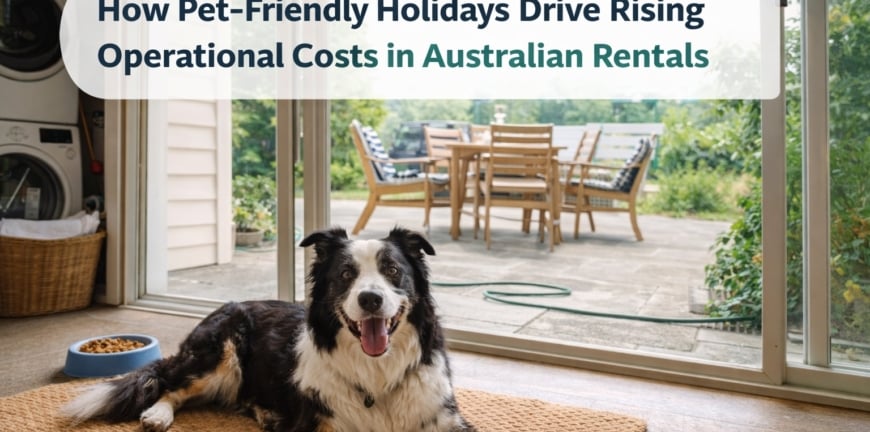
Hidden Utility Costs of Pet-Friendly Holiday Rentals in 2026
The Hidden Utility Costs of Pet-Friendly Holiday Rentals in 2026.
For many hosts, utilities are now the fastest-growing hidden cost after cleaning.
Australian holiday rental owners, who promote the “Pet-Friendly” badge will know that it is more than a search filter. It represents a promise that families can travel without leaving their four-legged members behind.
But in 2026, that promise carries rising operational implications.
Pet-friendly rental hosts we have talked to often report that utilities are now the fastest-growing hidden cost after cleaning. Understanding those hidden utility dynamics is becoming increasingly important for long-term profitability. With pet ownership remaining high and energy markets continuing to fluctuate, many hosts are discovering that pet-friendly accommodation can carry a different cost structure to standard short-term rentals.
This guide is designed for Australian short-term rental hosts and property managers looking to better understand how pet-friendly accommodation can influence ongoing utility costs and operational decisions.
Pet Ownership Is Driving Demand but Also Operational Expectations
Pet-friendly travel is not a fringe segment. According to Animal Medicines Australia’s Pets in Australia report, approximately 73% of Australian households own at least one pet. That translates into millions of travellers who actively seek accommodation that welcome animals.
As a result, pet-friendly listings have become a competitive advantage in many regional and coastal markets.
However, higher demand also brings elevated guest expectations and often higher property turnover intensity.
The Laundry Load: A Hidden Energy Multiplier
One of the most significant operational differences in pet-friendly accommodation lies in cleaning protocols.
Between guests, hosts often:
- Wash pet bedding or blankets
- Run sanitise or high-temperature wash cycles
- Increase drying time to eliminate odours
- Clean soft furnishings more frequently
Laundry appliances, particularly when operating on hot water cycles, are among the higher energy-consuming appliances in Australian homes (YourHome.gov.au).
If a standard rental might run two laundry loads per turnover, a pet-friendly property may run three or four especially after longer stays.
When multiplied across peak seasons, that difference can become material.
Water usage can also increase, particularly in regions where guests rinse pets outdoors or wash down patios and fenced areas.
Climate Control for Pet Safety
Another operational nuance involves heating and cooling.
While many guests take their pets with them during outings, some animals remain inside the property for short periods. To reduce heat stress risk or cold discomfort, air-conditioning or heating is often left running longer than it would be in a non-pet stay.
Heating and cooling account for approximately 40% of household energy use in Australia (YourHome.gov.au). In warmer states or during peak summer, that share can increase significantly.
For properties in Queensland, northern NSW, or inland WA where temperatures can climb quickly leaving air-conditioning active during daytime hours may be viewed as both a welfare and property protection measure.
But it is also a direct cost consideration.
For example, in warmer regions, hosts often leave air-conditioning running for several hours while guests are out to maintain a safe indoor temperature for pets. Over time, this extended usage can contribute to higher-than-expected energy consumption compared to non-pet-friendly properties.
The Digital Guest Experience Has Expanded
In 2026, a pet-friendly rental is expected to provide more than a water bowl.
Guests increasingly travel with:
- Pet monitoring cameras
- Smart collars
- Automated feeders
- Streaming-heavy households
Insights discussed on the Econnex Comparison blog note that performance can vary across NBN speed tiers, which may influence how well connected devices function in short-term accommodation settings.
Hosts who upgrade from basic plans to higher-speed tiers to prevent buffering or dropouts may face higher monthly telecommunications expenses.
In properties where multiple devices operate simultaneously, upgrading bandwidth may be less of a luxury and more of a practical requirement.
Overlaying Energy Market Volatility
Beyond pet-specific usage patterns, hosts are also navigating broader electricity market changes.
According to the Econnex Comparison blog on average electricity bills in Australia, typical annual electricity costs have risen in recent years across several states, in some cases by close to 9 % year-on-year under the Default Market Offer (DMO) price benchmark for 2025–26 compared to the previous year. These changes reflect broader movements in wholesale, network and retail cost components that feed into household bills and can make electricity pricing feel unpredictable for many consumers.
While individual retailer offers vary, electricity pricing volatility has become a defining feature of recent years.
For hosts who adopted a “set and forget” approach to utilities signing contracts years earlier and renewing automatically, the risk is remaining on plans that no longer reflect competitive market rates.
Why Utilities Deserve More Strategic Attention
Short-term rental operators often focus heavily on revenue levers:
- Nightly rate optimisation
- Occupancy levels
- Seasonal pricing
- Channel mix
However, margin preservation is equally powerful.
Unlike pricing, which is constrained by market competition, cost efficiency can be influenced internally.
Energy plans can differ meaningfully in:
- Time-of-use pricing structures
- Peak vs off-peak rates
- Solar feed-in tariffs
- Demand charges
- Exit fees
- Contract lengths
For example, if heavy laundry and cleaning activity consistently occurs on Mondays between 10am and 3pm, a time-of-use tariff charging higher peak rates during those hours could inflate costs compared to a flat-rate structure.
Similarly, regional properties with rooftop solar may benefit from periodically reviewing feed-in tariffs, as rates vary across retailers.
The AER recommends reviewing Basic Plan Information Documents (BPIDs) to understand plan structures and compare offers accurately.
As operating expenses change over time, pet-friendly accommodation providers may periodically review different aspects of their property’s running costs.
How Hosts May Review Operational Costs
Bundled Services Review
Some hosts explore whether combining electricity, gas and internet services differs from maintaining separate plans, particularly as pricing structures and inclusions evolve.
Solar Considerations
For properties with solar panels, feed-in tariff rates may be reviewed to understand how export credits compare with current retailer offerings.
Usage Timing
Where practical, certain activities such as cleaning or running heavy appliances can be scheduled with reference to tariff periods.
Telecommunications Checks
Internet speed tiers may be reassessed to consider whether they align with guest usage requirements.
Administrative Management
Managing multiple utilities across providers can involve additional administration. Some operators choose to review available electricity, gas and telecommunications options through comparison platforms to view participating providers in one place, depending on their location and needs.
Overall, this reflects a shift toward periodic review rather than ongoing passive management.
A Broader Sustainability Question
Pet-friendly accommodation contributes meaningfully to Australia’s tourism ecosystem, particularly in regional areas.
However, sustainability in this niche is not just environmental, it is financial.
If rising operational costs consistently outpace pricing flexibility, hosts may reconsider offering pet-friendly stays altogether.
That outcome would reduce accommodation choice for travelling families and impact local economies that benefit from extended-stay visitors.
Cost management, therefore, becomes part of protecting the long-term viability of the segment.
Balancing Guest Experience with Financial Reality
Guests increasingly expect:
- High cleanliness standards
- Climate comfort
- Fast Wi-Fi
- Transparent pricing
Delivering these while protecting margins requires ongoing operational awareness.
Comparing essential utility bundle services including electricity, gas and internet is not the only cost lever available to hosts. But it is one that can be reviewed without changing the guest experience itself.
In contrast to reducing amenities or raising rates, utility plan optimisation operates behind the scenes.
Final Thoughts
Pet-friendly accommodation reflects hospitality at its most inclusive. It allows families to travel together and supports tourism across Australia’s regional communities.
But inclusivity must remain economically sustainable for hosts.
As utility markets evolve and property usage patterns shift, periodically reviewing essential services may help ensure plans align with actual consumption and current market structures.
For hosts navigating 2026’s cost environment, small operational adjustments repeated consistently can compound meaningfully over time.
Disclaimer: This article provides general information only and does not take into account your personal circumstances or business needs. It is not professional advice. Utility prices, features, availability and eligibility vary by provider, usage and location and may change over time. Always review the relevant plan information and terms before switching. Econnex Comparison compares plans from participating providers only and does not compare all products or providers in the market.