September 1, 2026
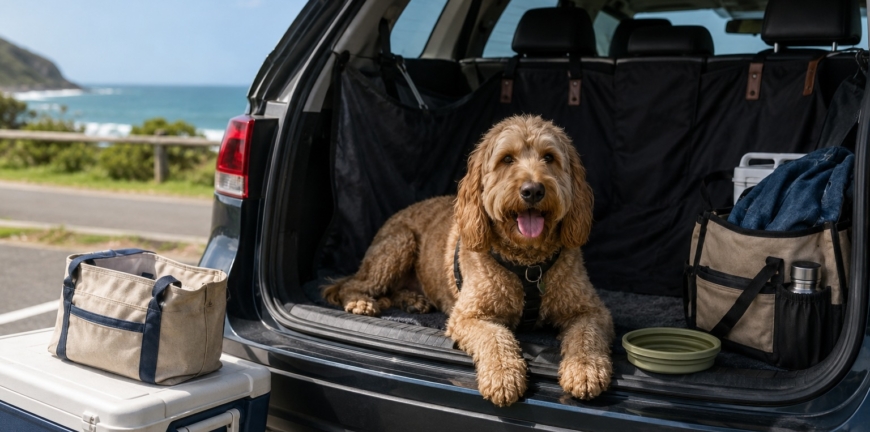
Dog-Friendly Road Trips in Australia: Essential Safety Tips
Finding the accommodation is the easy part. Australia has more dog-friendly cabins, caravan parks and boutique hotels than at any point in the last decade, and booking one takes minutes. The part most owners underestimate is everything between the front door and the check-in desk, and the first few hours after arriving.
After years of researching and writing about pet-friendly travel in Australia, I have found that the property itself is rarely the difficult part.
Here is what is worth sorting before the car is loaded.
Restraint is not optional
Rules around transporting dogs vary between Australian states and territories, but an unrestrained dog can create both a serious safety risk and, in some circumstances, a legal problem. Requirements are particularly clear for dogs travelling in open vehicles such as utes and trailers. Even where legislation does not prescribe a specific type of restraint inside a car, keeping a dog securely contained or restrained is widely recommended for the safety of both the animal and the people in the vehicle.
In New South Wales, Victoria and Queensland an unrestrained animal can attract a fine, and if the dog is judged to have interfered with the driver’s control, demerit points as well. Enforcement is inconsistent, but the physics are not. In a sudden stop or collision, an unrestrained dog can become a dangerous projectile, potentially injuring both itself and vehicle occupants.
Two options work: a crash-tested harness clipped to a seatbelt anchor, or a secured travel crate in the boot. Standard walking harnesses are not designed for crash loads and should not be used as restraints. If you are driving a ute, a dog in an open tray must be tethered, and on a hot day the tray itself can burn paw pads within seconds.
Protect the car before it needs protecting
Sand, mud, moulted coat and the occasional car-sick episode are a normal part of travelling with a dog, and they are much easier to prevent than to remove. A fitted cover across the back seat catches almost all of it, and hammock-style covers have the added benefit of stopping a dog sliding into the footwell under braking. The decision usually comes down to whether you want a bench cover or full hammock coverage, and how well it anchors, because the cheap ones migrate within a few hundred kilometres. There is a useful breakdown of seat covers built for dogs that compares construction and fit across common Australian vehicles.
For wagons and SUVs where the dog travels in the boot, a moulded cargo liner does the same job and is generally easier to hose out.
The real risk is arrival, not the drive
Most owners worry about the journey. The genuine danger point is the first hour at an unfamiliar property.
A dog that has never been to a location has no scent map home. If it slips a lead in the car park, bolts at a strange noise, or finds a gap in unfamiliar fencing, its instinct is to run, and unlike at home it has no idea which direction leads back to you.
One of the first things I do when arriving at a pet-friendly property is walk the boundary before unloading everything else. Holiday rental descriptions often say “fully fenced”, but what that means in practice can vary enormously.
Microchipping is mandatory across Australia and it matters, but a microchip is a recovery tool rather than a location tool. It only helps once somebody has already caught your dog and taken it to a vet or pound. If you want to know where the dog is right now, you need something that reports its position.
This is where a tracker earns its place. The main decision is whether to accept an ongoing subscription. Full cellular trackers give near-live location over the mobile network but almost all require a monthly or annual plan. There are also GPS trackers that work without a subscription, which trade some range or update frequency for no recurring cost, a reasonable swap if the tracker is mainly for travel rather than daily use.
Whichever type you choose, check coverage before you rely on it. Large parts of regional Australia have patchy mobile reception, and a tracker that depends on a network will be silent exactly where you would most want it working. Test the device at home first so you know how it behaves before you need it.
Heat, water and breaks
Plan a stop roughly every two hours. Dogs need the toilet break less than they need to reset, because long confinement raises stress and a stressed dog arrives badly.
Never leave a dog in a parked car in Australian conditions, including on days that do not feel especially hot. As reported by the RSPCA, on a 29C day the interior of a parked car can exceed 44C within ten minutes, and cracking a window makes almost no difference. If a stop requires leaving the dog, one person stays with it or the stop does not happen.
Carry more water than you think you need, plus a collapsible bowl. Water left standing in a hot car grows bacteria quickly, so refresh it rather than topping it up.
Paperwork worth having
Most pet-friendly properties ask for nothing, but some, particularly caravan parks and farm stays, require proof of current C5 vaccination, and a few ask for evidence of recent flea and worming treatment. Photograph the vaccination certificate and keep it on your phone rather than hunting for the paper copy at check-in.
It is also worth saving your vet’s contact details along with the nearest emergency vet to where you are staying. Looking that up calmly on the night you arrive is far better than searching for it at 11pm during an actual problem.
Setting up well at the other end
Bring the dog’s own bed or a blanket from home. Familiar scent does more for settling than anything you can buy on arrival, and it also keeps hair off the property’s furniture, which hosts appreciate.
Before you let the dog off lead anywhere on the property, walk the boundary yourself. Fencing at holiday rentals is frequently decorative rather than functional, and gaps that a dog will find in thirty seconds are easy to miss at a glance. Check gate latches too, because plenty of rural properties have gates that close but do not actually catch.
Finally, check the local council rules. Leash requirements, off-leash areas and dog beach access vary considerably between councils, and the rules that apply at home very often do not apply where you are going. Most councils publish this on their website and it takes two minutes to look up.
The short version
Restrain the dog properly, protect the car before the mess happens, make sure you can locate the dog if it runs, plan real breaks, and spend ten minutes checking the property before you trust it. Do those five things and the trip generally takes care of itself.
Before You Leave: Quick Checklist
- Dog restraint or secured crate
- Lead and spare lead
- Updated ID tag
- Microchip details checked
- GPS tracker charged and tested
- Water and travel bowl
- Food and medication
- Vaccination records saved to your phone
- Familiar bedding
- Towel and cleaning supplies
- Emergency vet details at your destination
- Local council dog rules checked
Author Bio
Carla Francis is an author and pet travel specialist. She is the author of Travelling with Pets on Australia’s East Coast and several internationally published books about animals and human-animal relationships. Her work combines practical pet travel experience with qualifications in animal behaviour.